
Text-to-image and text-to-video AI has dominated headlines, but music generation is evolving just as fast. Google DeepMind’s Lyria is a state-of-the-art music generation model that creates high-quality tracks from text prompts, complete with accompaniment, lyrics, and vocals.
This article summarizes Lyria’s technical features, usage methods, platform availability, and safety mechanisms based on official documentation.
Table of Contents
- What is Lyria?
- Key Features and Capabilities
- Technical Architecture
- Access Methods and Platforms
- Primary Use Cases
- Limitations and Considerations
- Safety Design and Copyright Protection
- Summary
What is Lyria?
Lyria is Google DeepMind’s latest music generation model. Specify a mood or genre via text prompt, and Lyria automatically generates ~30-second high-quality tracks containing accompaniment, lyrics, and vocals. The model is rolling out gradually through YouTube Shorts’ experimental Dream Track feature and developer APIs, targeting professional creators and general users alike.
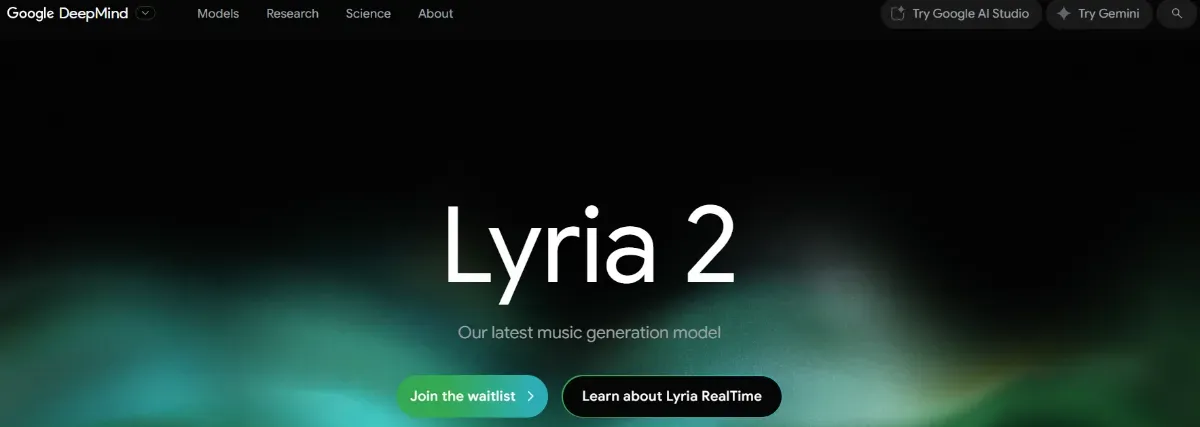
Source: https://deepmind.google/models/lyria/
Key Features and Capabilities
Lyria combines multiple technical and functional capabilities to meet diverse user needs:
-
Professional-grade 48 kHz stereo output that can be used directly in videos and streams without additional mastering
-
Vocal synthesis generates accompaniment, lyrics, and vocals in one pass, supporting styles from solo performances to choir arrangements
-
Fine-grained controls allow users to specify key, tempo, instruments, negative prompts, and seed values for precise creative control
-
Real-time generation model (Lyria RealTime) supports synchronized music generation with live performance
-
SynthID watermarking embeds invisible digital watermarks in all generated audio, enabling post-hoc identification of AI-generated content for copyright and content management purposes
Technical Architecture
Lyria achieves natural music generation by combining multiple cutting-edge technologies:
-
Text-to-Music Pipeline Text → embedding representation → multi-layer neural network → 48 kHz audio decode. Optimized to handle multiple instruments and vocals simultaneously.
-
Long-Sequence Learning Generates phrases lasting tens of seconds while maintaining temporal coherence, enabling continuation and rearrangement workflows.
-
Multimodal Transformation The same underlying technology powers Music AI Sandbox tools that transform humming or MIDI input into different musical styles.
These components enable Lyria to handle diverse music genres and produce natural, coherent music generation.
Access Methods and Platforms
Lyria is not yet broadly available—access remains staged and targeted to specific use cases and user segments. Here are the primary access methods:
-
YouTube Shorts “Dream Track” Experimental feature available to select creators. Generates 30-second tracks in the vocal styles of partner artists.
-
Music AI Sandbox Web tool for indie producers and musicians. Adds accompaniment or transforms style from humming or audio input. Waitlist-only.
-
Vertex AI / Gemini API Developer and enterprise channel. API-driven instrumental music generation (vocal generation not yet supported).
-
Google AI Studio Interactive environment for developers and researchers to experiment with the real-time model Lyria RealTime.
These access methods are expected to expand over time, eventually reaching general users.
Primary Use Cases
Lyria offers practical functionality for everyday content creation and musical expression. Social media reactions demonstrate strong interest in its capabilities:
Building on this momentum, here are concrete use cases:
-
Video Background Music Enter “calm lofi hip hop” → instant royalty-free BGM.
-
Social Media “Fan Songs” Use Dream Track to create 30-second tracks in your favorite artist’s style for Shorts or Reels.
-
Humming to Full Production Upload humming to Sandbox → AI arranges it into jazz, rock, cinematic, and other styles.
-
Compositional Ideation Compose 4 bars, let AI suggest continuations to accelerate creative workflows.
These workflows enable creative music production without specialized skills—a core strength of Lyria.
Limitations and Considerations
Despite advanced capabilities, Lyria’s current release form and technical constraints include several limitations:
-
Limited Access YouTube experiments, Sandbox, and API all require application or invitation. Broad public access is in preparation.
-
~30-Second Length Limit Dream Track and Vertex AI versions generate approximately 30 seconds. Longer compositions require multiple generations and editing.
-
English Prompt Optimization While Japanese prompts work, nuance may be lost. Short English keywords yield more reliable results.
-
Vocal Generation Partially Available Vertex AI does not yet support vocal generation (planned for future releases).
These limitations are expected to improve as the model and platform evolve. Users should understand current specifications and plan accordingly.
Safety Design and Copyright Protection
Lyria’s design includes mechanisms to support safe commercial use:
-
SynthID Watermarking Embeds invisible digital watermarks in generated audio, enabling post-hoc identification of AI-generated content.
-
Content Safety Filters Prevents generation of harmful lyrics or content, and suppresses unauthorized imitation of existing songs (repetition checks).
-
Intellectual Property Indemnification Music generated through Google Cloud’s Vertex AI is covered by copyright infringement indemnification, protecting both training data usage and generated audio assets.
-
Commercial Use Permitted Audio generated via Vertex AI can be used in commercial projects (marketing, video production, brand background music, etc.), making it accessible to enterprises.
Lyria’s combination of safety measures and commercial licensing makes it a compelling music generation tool for professional and general use.
Summary
Lyria combines high-fidelity output, vocal support, and fine-grained controls in a single music generation AI. While still in limited testing, it already demonstrates clear benefits:
- Accelerated background music production
- Expanded social media creative options
- Breakthrough compositional assistance
As public release expands, we’re approaching an era where anyone can generate “their own music” from a single text prompt. Master the mechanics and workflows now to stay ahead of the music production curve.