
Adding natural narration to videos and materials traditionally required external voice actors or narrators. With the advancement of AI voice generation, services that can create realistic voices from text input alone have emerged. A prime example is NIJI Voice.
This guide covers NIJI Voice’s overview, features, pricing structure, official use case categories, and the service model transition planned for October 2025.
Table of Contents
- NIJI Voice Overview and Background
- Key Features and Strengths
- Pricing Plans
- Usage Workflow
- Use Case Examples
- Service Model Migration After October 2025
- Prerequisites and Important Notes
- Summary
NIJI Voice Overview and Background
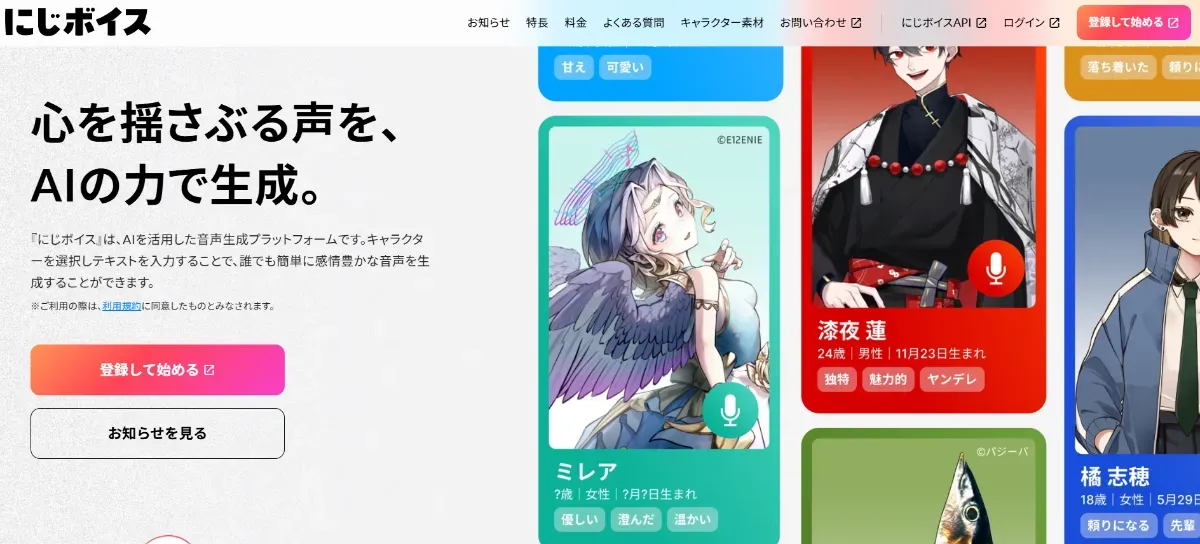
Source: https://nijivoice.com/
NIJI Voice is an AI voice generation service developed and provided by Algomatic Inc., a DMM Group company. Officially launched in December 2024, it generates high-quality voices simply by entering text.
Unlike conventional synthetic speech, it excels at intonation and emotional expression while supporting commercial use. Additionally, it implements a revenue-sharing mechanism for voice providers, operating as a sustainable service model.
Key Features and Strengths
NIJI Voice features directly translate into practical benefits for business and production use. The core functions and mechanisms break down as follows:
Diverse Voice Models
Over 100 voice models are available, with detailed settings for age, personality, and atmosphere.
-
Covers a wide range from bright character voices to calm narration
-
Special vocal qualities including Kansai dialect and whisper (ASMR) voices available
-
Regular addition of new models through an ongoing release mechanism
This extensive variety allows optimal voice selection tailored to specific uses—advertising, training, product explanations, and more.
Natural Speech with Emotion Expression
Unlike traditional mechanical synthetic voices, NIJI Voice applies natural intonation based on text context and punctuation.
-
Voice tone changes with ”!” or ”?” input
-
Automatically expresses emphasis and emotional fluctuations in sentences
-
Generates narration that doesn’t feel unnatural to listeners
This enables realistic audio with professional recording quality in a short time.
Commercial Use Support
To ensure safe use in business scenarios, commercial use is permitted. As long as proper credit attribution is provided (e.g., “Voiced by NIJI Voice” or “にじボイス”), it can be safely used in video advertising, educational materials, announcements, and more. The royalty return mechanism to voice model providers ensures transparency and trust.
-
Available for video ads, product PR, internal training, and more
-
Public release possible with proper credit attribution per terms of service
-
API integration supported for embedding into proprietary apps and services
The service realizes a balance between “ease of use” and “rights protection.”
Revenue Sharing Model
Adopts a mechanism where voice providers (voice partners) receive royalties from a portion of usage fees.
-
Not the “unauthorized use” common in synthetic voice services, but legitimate use based on contracts
-
Expected as a sustainable model where creators receive revenue returns
-
Serves as the foundation for future addition of new voice models
This allows users to recognize the service as “safe and trustworthy.”
These features make NIJI Voice a service combining “quality,” “security,” and “versatility.”
Pricing Plans
Pricing operates on a monthly subscription basis, with multiple plans based on available character count.
| Plan | Monthly Fee | Character Limit | Target Users |
|---|---|---|---|
| Free | ¥0 | 1,000 characters | Trial and testing |
| Start | ¥490 | 5,000 characters | Small-scale use |
| Basic | ¥980 | 10,000 characters | Ongoing production |
| Standard | ¥2,940 | 30,000 characters | Active individuals / small teams |
| Premium | ¥9,800 | 100,000 characters | Professional creators |
| Pro | ¥44,980 | 500,000 characters | Production company scale |
| Business | ¥82,500 | 1,000,000 characters | Enterprise use |
| Enterprise | Custom | Custom | Large-scale use |
Start with the Free plan to test, then upgrade based on usage frequency.
Additionally, the API version is offered in a prepaid format, billing per 10,000 characters. This enables integration of voice generation functionality into proprietary apps and services.
Usage Workflow
Access the official site and create an account.
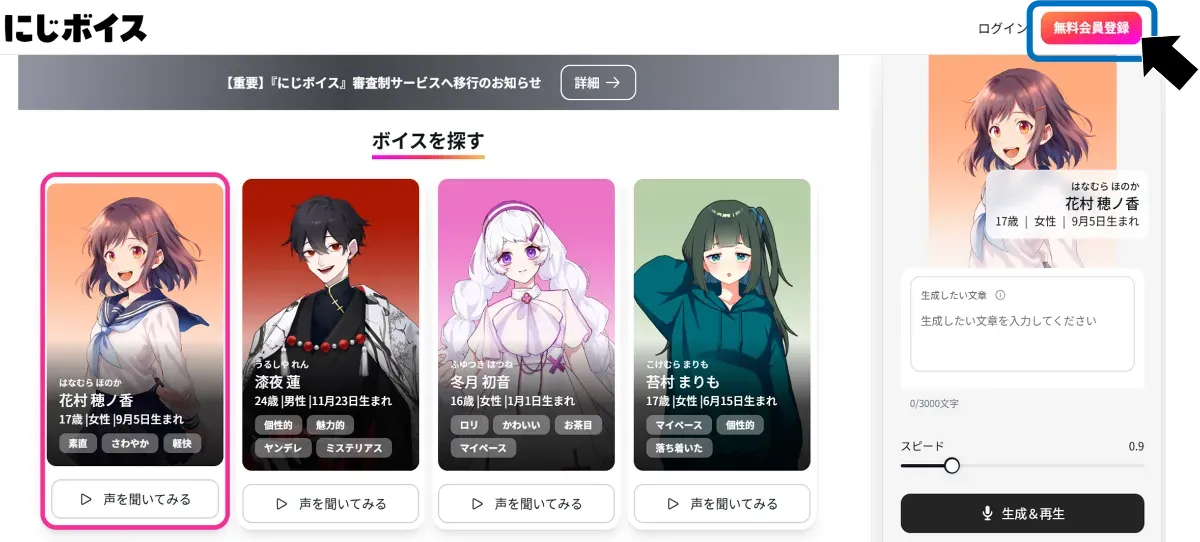
Select a voice model from the top page menu and specify your preferred voice. Enter text in the input field to generate audio, which can be played back immediately.
Generated audio can also be downloaded in MP3 format. The operation follows on-screen guidance, making it easy to use even for first-time users.
Use Case Examples
NIJI Voice can be utilized in scenarios such as:
-
SNS Video Advertising Enhancing expressiveness in SNS promotional videos with natural narration
-
Educational and Training Videos Application as narration support in e-learning materials and internal training
-
Virtual Assistants Adding voices to AI characters for enhanced user interaction expressions
Potential applications span from ad production to internal education and customer service.
Service Model Migration After October 2025
According to official announcements, the service will end “public access” provision at 10:00 on October 1, 2025, and migrate to “審査制 (review-based) closed premium format”. This means users must pass pre-screening before starting use, requiring preparation for prior application and review processes when implementing the service.
【重要】『にじボイス』審査制サービスへ移行のお知らせ
— にじボイス公式アカウント (@nijivoice_jp) July 30, 2025
『にじボイス』は、2025年10月1日(水)10:00より公開形式でのご提供を終了し、審査制のクローズドプレミアムサービスへ移行いたします。移行理由や、クローズドプレミアム版の利用方法は下記をご確認ください。https://t.co/kRpG4buwMo
Prerequisites and Important Notes
When considering implementation, note the following points:
-
Generated audio requires credit attribution
-
Cannot be used for purposes prohibited in the terms of service (adult content, illegal activities, etc.)
-
Can be integrated into existing systems and apps using the API
When properly following the rules, the service can be safely utilized across a wide range of business scenarios.
Summary
NIJI Voice is an AI voice generation service featuring abundant voice selection and natural speech expression. With a free plan available, you can start by testing the quality. It supports commercial and business applications, with API-based service integration possible. Since it will transition to a review-based system after October 2025, early action is advisable if considering implementation. We recommend checking the official site for service model changes and preparing for flexible adaptation as much as possible.